How to Make Flash USDT and What Is the Working Method
· based on the channel Rca FastPrint
Flash USDT is a method involving the creation and interaction with a USDT-like token using smart contracts on the Ethereum blockchain. This process is facilitated by tools such as ChainIDE, a development environment for smart contracts, and MetaMask, a popular Ethereum wallet interface. The Flash USDT method allows users to develop, test, and interact with ERC20 tokens in a controlled, educational setting.
What Is Flash USDT and How Does It Work
Flash USDT refers to a custom-created USDT token clone based on the ERC20 token standard. It is not official Tether (USDT) but a token created for educational, testing, or experimental purposes. The working method involves writing a smart contract that mimics USDT's functionality, deploying it on a test or main Ethereum network, and then interacting with it via a wallet like MetaMask.
This method is particularly useful for developers learning about token creation, smart contracts, and blockchain interactions without risking real funds. The process includes:
- Writing the smart contract code for the USDT token.
- Deploying the contract using ChainIDE.
- Connecting MetaMask to the Ethereum network.
- Interacting with the deployed token contract to mint, transfer, or check balances.
The official tutorial and script are available at Flash USDT ChainIDE Script.
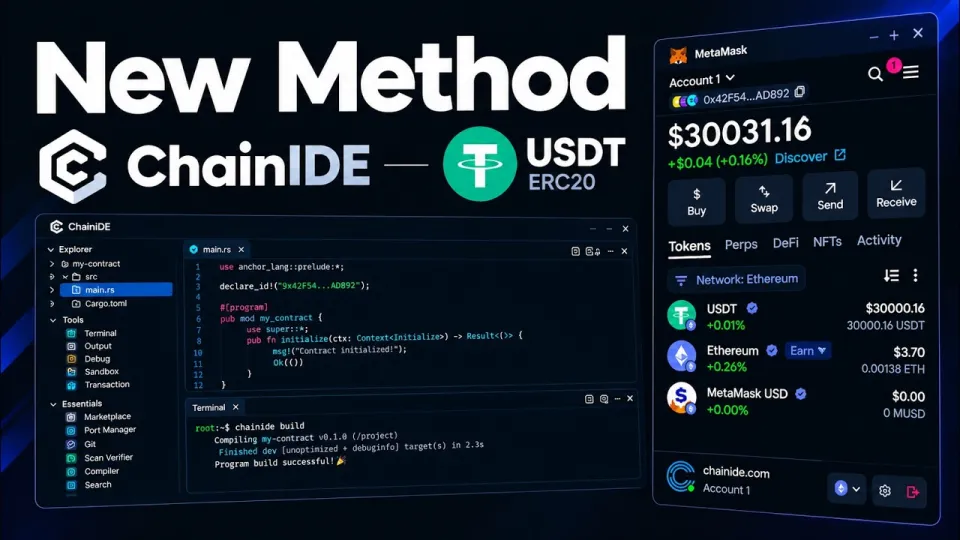
Setting Up ChainIDE for Flash USDT Creation
ChainIDE is an online integrated development environment designed for Ethereum smart contract coding and deployment. To create Flash USDT:
- Access ChainIDE and create a new project.
- Use the provided ERC20 token script tailored for Flash USDT.
- Compile the Solidity contract ensuring there are no errors.
- Deploy the contract to an Ethereum testnet or mainnet, depending on your purpose.
ChainIDE provides a user-friendly interface to view contract code, compilation results, and deployment status. It supports multiple Solidity versions and debugging tools.
Understanding the ERC20 Token Structure for Flash USDT
Flash USDT tokens are structured based on the ERC20 standard which defines the following key functions and properties:
- `totalSupply()` to get the total token amount.
- `balanceOf(address)` to check balances.
- `transfer(to, amount)` to send tokens.
- `approve(spender, amount)` and `transferFrom(from, to, amount)` for delegated transfers.
The Flash USDT smart contract includes these standard functions with additional metadata such as token name, symbol (USDT), and decimals (commonly 6 or 18). Understanding this structure is crucial for proper token interaction and integration with wallets like MetaMask.
Connecting MetaMask and Interacting with Flash USDT
MetaMask acts as a bridge between the user and the Ethereum blockchain. The steps to connect and interact with Flash USDT are:
- Install MetaMask browser extension or mobile app.
- Connect MetaMask to the Ethereum network where the Flash USDT contract is deployed.
- Import the Flash USDT token contract address into MetaMask to view token balances.
- Use MetaMask’s interface or a decentralized application (dApp) to call contract functions such as transferring tokens.
MetaMask ensures secure transaction signing and wallet management, making it essential for working with Flash USDT tokens.
Smart Contract Development Workflow and Testing
Developing Flash USDT involves a clear workflow:
- Code: Write the Solidity contract using the ERC20 template.
- Compile: Use ChainIDE to compile and check for errors.
- Deploy: Deploy the contract on a test network first to avoid loss.
- Test: Conduct token minting, transfers, and balance checks.
- Verify: Confirm contract source code on blockchain explorers.
Testing is critical to ensure the contract behaves as expected. It prevents potential bugs or security flaws before any real funds are involved.
Common Mistakes and Precautions When Creating Flash USDT
Users should be cautious with the following:
- Never send real funds to unverified contracts.
- Always verify the contract address and source code.
- Check the network (testnet or mainnet) before transactions.
- Avoid interacting with unknown or suspicious contracts.
These precautions protect users from scams and loss of assets. The Flash USDT method is educational and should be used responsibly.
Useful Links
- Official Flash USDT ChainIDE Script and Guide: https://sites.google.com/view/defiflashusdt
Conclusion
Creating Flash USDT is a practical way to learn about ERC20 tokens, smart contracts, and blockchain interaction using ChainIDE and MetaMask. This method provides a hands-on experience with token creation and wallet integration while emphasizing safety and verification. For a detailed walkthrough and script, visit the official resource at https://sites.google.com/view/defiflashusdt. Thanks to the channel Rca FastPrint for the comprehensive breakdown of this method.
Key takeaways
- Flash USDT uses ERC20 token standards on Ethereum.
- ChainIDE is used to write and deploy the smart contract.
- MetaMask connects the wallet to interact with the contract.
- The method involves development, testing, and verification steps.
- Always verify contract details before transacting.
Source: How to Make Flash USDT | Working Method 2026 · Markdown version
Questions & answers
What is Flash USDT?
Flash USDT is a custom ERC20 token that mimics USDT functionality, created for educational and testing purposes using smart contracts.
Which tools are used to create Flash USDT?
ChainIDE is used to write and deploy the smart contract, while MetaMask is used to connect the wallet and interact with the token.
Is Flash USDT the same as official USDT?
No, Flash USDT is a token clone for development and testing, not the official Tether USDT token.
Can I use Flash USDT with real funds?
No, it is recommended to only use Flash USDT for testing and development and never send real funds to unverified contracts.